Will AI Make Us Dumb? AI, Media & McLuhan pt. 3


The Impact of AI on Human Cognition
Fellow millennials, how many phone numbers did you used to have memorized? Since getting a cell phone, do you struggle even to remember your own? So, did cell phones destroy our memory?
Kinda, lol. 🥴
But research has found that this "digital amnesia" also frees up cognitive resources for problem-solving and creativity.
I think we can imagine using AI regularly will have a similar effect.
AI as a New Medium
I've been thinking about AI through the lens of Marshall McLuhan's framework for understanding new media. One of his famous observations is that a medium extends an existing human faculty:
Photography extends seeing.
Radio extends voice and hearing.
AI, it can be said, extends our ability to think... to a point. 🤔
It certainly surpasses us in some mental tasks, such as:
👉 Memory
👉 Pattern recognition
👉 Problem-solving
👉 Sheer speed of thought
(Some, like the folks at Midjourney, even argue that AI extends our ability to imagine.)
AI as a Co-Thinker
But AI is not just "brain steroids." It’s a parallel system that complements, enhances, and sometimes disrupts our thinking processes. To make the best use of it, we may need to redefine how we think, treating AI as a tool for Co-Thinking:
👉 Idea Generation – AI can help brainstorm and refine creative concepts.
👉 Augmented Understanding – AI can assist in learning new topics and clarifying concepts.
👉 Dialogue & Interaction – AI can act like a Socratic dialogue partner, enabling iterative drafting and deeper exploration of ideas.
AI’s Limitations and the Human Factor
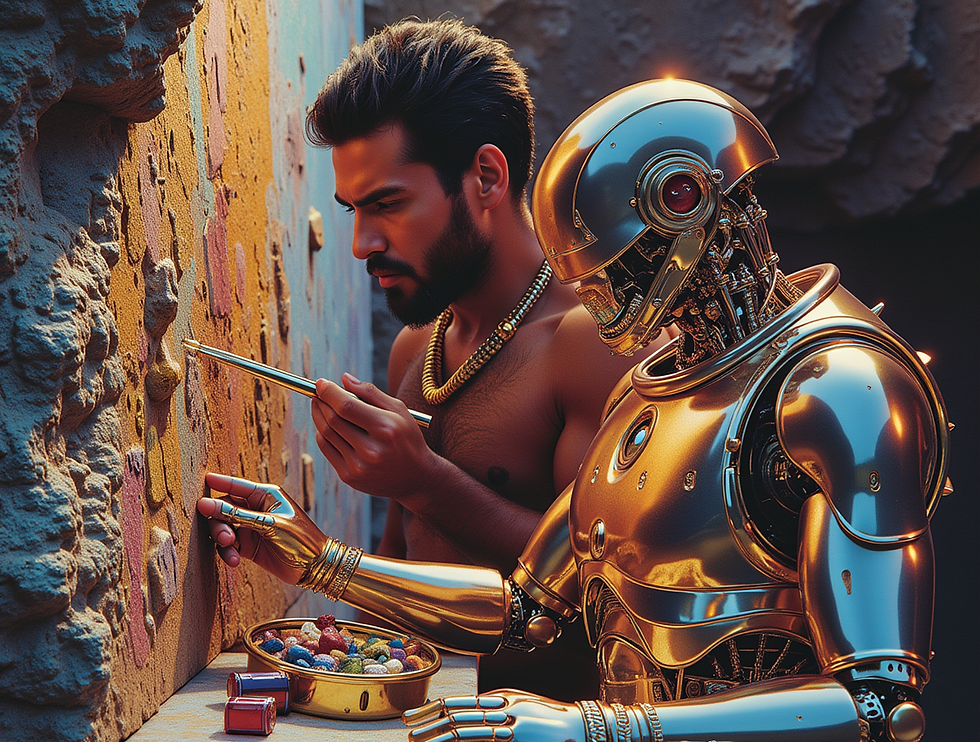
AI is far from a perfect partner. Its limitations force us to pick up the slack in crucial areas. AI cannot generate meaning or value judgments on its own, nor does it possess the emotional or ethical dimensions of human thought.
🤖 In gaming parlance, this represents a reconfiguration—a "re-specking into a new build." Are we becoming a kind of technomancer class?
A Countermovement?
To speculate further: Is this new mode of thinking and creation setting up a countermovement that re-values intuition, empathy, and the uniquely human aspects of cognition?
If AI reconfigures our cognitive load, perhaps it also highlights the areas where human intellect remains irreplaceable.


Comments